
No products in the cart.
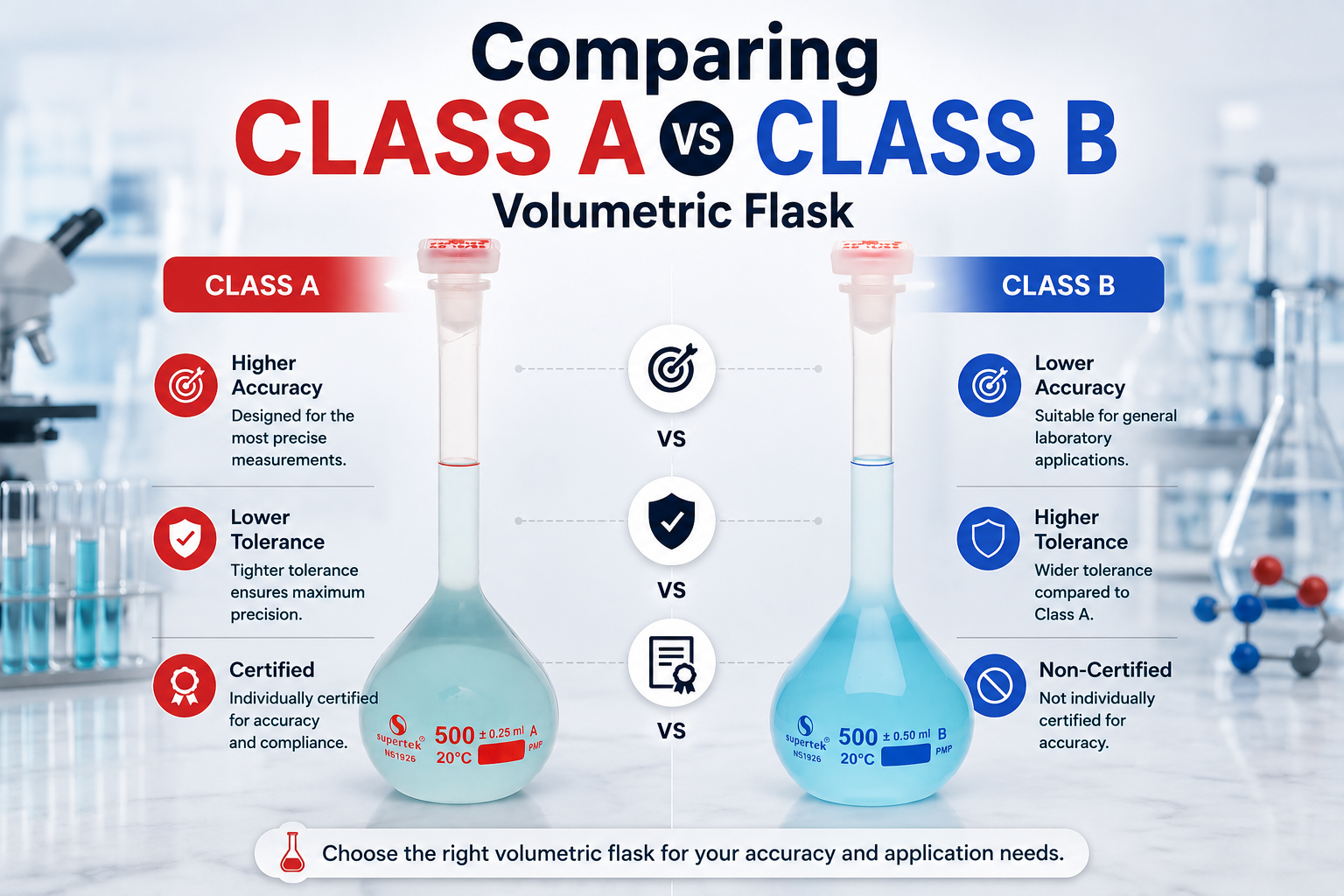
Comparing Class A vs Class B Volumetric Flask
A volumetric flask is one of the most commonly used tools in laboratories. It is specially designed to measure a fixed amount of liquid with high precision. The flask has a round bottom, a narrow neck, and a marking line that shows the exact volume level. A laboratory volumetric flask is mainly used when scientists or students need to prepare solutions with accurate concentrations.
You will often find a chemistry volumetric flask in research labs, pharmaceutical companies, colleges, schools, and chemical industries. Even a tiny mistake in liquid measurement can change the outcome of an experiment. Because of this, laboratories use volumetric flasks for reliable and repeatable results.
These flasks are available in different sizes and designs. Among the various types of volumetric flasks, the most important classification is Class A and Class B. Both are used for measuring liquids, but their accuracy levels and applications are different.
What is a Class A Volumetric Flask?
A Class A volumetric flask is made for laboratories where precision matters the most. These flasks are manufactured under strict standards to provide highly accurate measurements. In many cases, they are individually calibrated and supplied with certification from the manufacturer.
The biggest advantage of a Class A flask is its low tolerance range. The Class A volumetric flask tolerance is much smaller compared to ordinary laboratory flasks. This means the measured liquid volume stays very close to the marked value on the flask.
These flasks are widely used in pharmaceutical labs, analytical chemistry, research centers, and quality testing laboratories. In such places, even a slight variation in measurement can affect the final result.
Most Class A flasks are made from borosilicate glass because it can handle chemicals and temperature changes without damage. Another important feature is Class A flask accuracy, which helps researchers prepare exact chemical solutions for sensitive experiments.
What is a Class B Volumetric Flask?
A Class B volumetric flask is used for general laboratory work where extremely high precision is not always necessary. It looks similar to a Class A flask but has slightly higher tolerance limits. Because of this, the measurements are less precise.
These flasks are commonly used in schools, training institutes, and routine laboratory operations. They are suitable for preparing solutions where a small difference in volume does not create major issues.
One reason many laboratories choose Class B flasks is affordability. They cost less than Class A flasks and are practical for day-to-day use. Most are not individually certified, but they still provide dependable performance for regular experiments.
Common Class B flask uses include student practical work, chemical mixing, and basic testing procedures. For non-critical laboratory tasks, they are considered a useful and economical option.
Class A vs Class B Volumetric Flask: Key Differences
When comparing Class A vs Class B volumetric flask models, the main difference comes down to measurement precision and calibration standards. Although both flasks are designed to hold a fixed liquid volume, their performance levels are different.
The difference between Class A and Class B volumetric flask becomes important when working with sensitive chemical solutions. Class A flasks are designed for high-accuracy work, while Class B flasks are intended for routine laboratory tasks.
| Feature | Class A | Class B |
| Accuracy | Higher | Moderate |
| Tolerance | Lower | Higher |
| Certification | Usually certified | Usually not certified |
| Cost | Higher | Lower |
| Usage | Analytical labs | General labs |
| Calibration Standard | Strict | Standard |
If a laboratory regularly performs analytical testing or pharmaceutical work, Class A flasks are usually preferred. For educational purposes and simple chemical preparation, Class B flasks work well.
Volumetric Flask Accuracy and Tolerance
Volumetric flask accuracy refers to how close the actual liquid volume is to the marked value on the flask. Accuracy is very important in laboratory work because incorrect measurements can change the strength of a chemical solution.
Tolerance is the acceptable variation allowed in a flask measurement. A flask with lower tolerance provides more precise results. This is why Class A flasks are considered more reliable for sensitive laboratory applications. Most flasks are calibrated at a standard temperature of 20°C. Temperature matters because liquids can expand or shrink slightly when heated or cooled.
For example, if a laboratory technician prepares a medicine solution using inaccurate measurements, the final concentration may become incorrect. This can affect experiment quality and testing reliability. Because of this, choosing the right volumetric flask in chemistry lab work is extremely important.
Applications of Class A and Class B Volumetric Flasks
Different laboratories use different flasks depending on the type of work being performed.
Class A flasks are commonly used for:
- Titration experiments
- Pharmaceutical formulation
- Analytical testing
- Research projects
- Preparation of standard solutions
These flasks are often treated as essential analytical chemistry glassware because they provide highly accurate measurements.
Class B flasks are mainly used for:
- Student practical experiments
- Routine solution preparation
- Basic chemical mixing
- Demonstration work in educational labs
A volumetric flask in laboratory settings helps ensure consistency while preparing chemical solutions. Both Class A and Class B flasks play an important role in daily laboratory operations.
Which Volumetric Flask Should You Choose?
The right flask depends on the level of precision needed in the laboratory. If the work involves sensitive experiments or exact chemical concentrations, a calibrated volumetric flask from Class A is usually the better choice.
For schools, colleges, and general chemical work, Class B flasks are often sufficient. They provide reasonable accuracy at a lower cost.
Budget, experiment sensitivity, and laboratory type should always be considered before buying laboratory glassware. Many facilities keep both options available for different applications.
Using the correct standard volumetric flask improves measurement reliability and overall laboratory efficiency.
Glass Quality and Material
Glass quality affects both safety and measurement performance in laboratories. A borosilicate volumetric flask is widely preferred because borosilicate glass has very good resistance to heat and chemicals.
This material can handle sudden temperature changes without cracking. It can also prevent unwanted chemical reactions during experiments. Clear graduation markings on high-quality glass make liquid measurement easier and more accurate.
Good laboratory glassware accuracy will also depend on proper manufacturing quality. Durable glassware will last longer and provide a consistent performance during repeated use.
Also Read: You can also read our Beaker vs Graduated Cylinder to understand how these laboratory containers differ in accuracy, design, and practical applications in everyday lab work.
Conclusion
Understanding the Class A vs Class B volumetric flask comparison helps laboratories select the right equipment for their needs. Class A flasks have better precision and lower tolerance, making them ideal for analytical and research applications. Class B flasks are more affordable and suitable for routine lab work.
Both flasks are useful in different situations, and choosing the correct one will improve experiment reliability and solution accuracy. Laboratories should always select glassware according to the level of precision needed.
Supertek provides the best, most dependable, and highest-quality volumetric glassware for educational, industrial, and research laboratories.
FAQs
Borosilicate glass is used because it offers strong chemical resistance and excellent thermal stability. It can handle laboratory conditions without easily cracking or reacting with chemicals.
Class B flasks are mainly used in educational institutions, student laboratories, and routine chemical preparation tasks where small measurement differences are acceptable.
The tolerance of a Class A flask is less compared to standard laboratory flasks. This allows more precise liquid measurements, which are important in analytical and pharmaceutical work.
Class A volumetric flasks are more accurate because they are produced with tighter tolerance limits and are often individually certified for precision laboratory applications.
The main difference is the accuracy of measurement. Class A flasks are manufactured with stricter calibration standards and lower tolerance limits, while Class B flasks have slightly higher tolerance levels and are mainly used for routine laboratory work.
Yes, Class B flasks can be used for simple analytical tasks. However, for highly sensitive testing and precise measurements, Class A flasks are generally preferred.
Yes, many Class A flasks are individually certified by manufacturers to confirm that they meet strict laboratory accuracy standards.
A calibrated volumetric flask is a flask tested to hold an exact liquid volume at a specified temperature, usually 20°C. Calibration helps maintain measurement accuracy in laboratory work.