
No products in the cart.
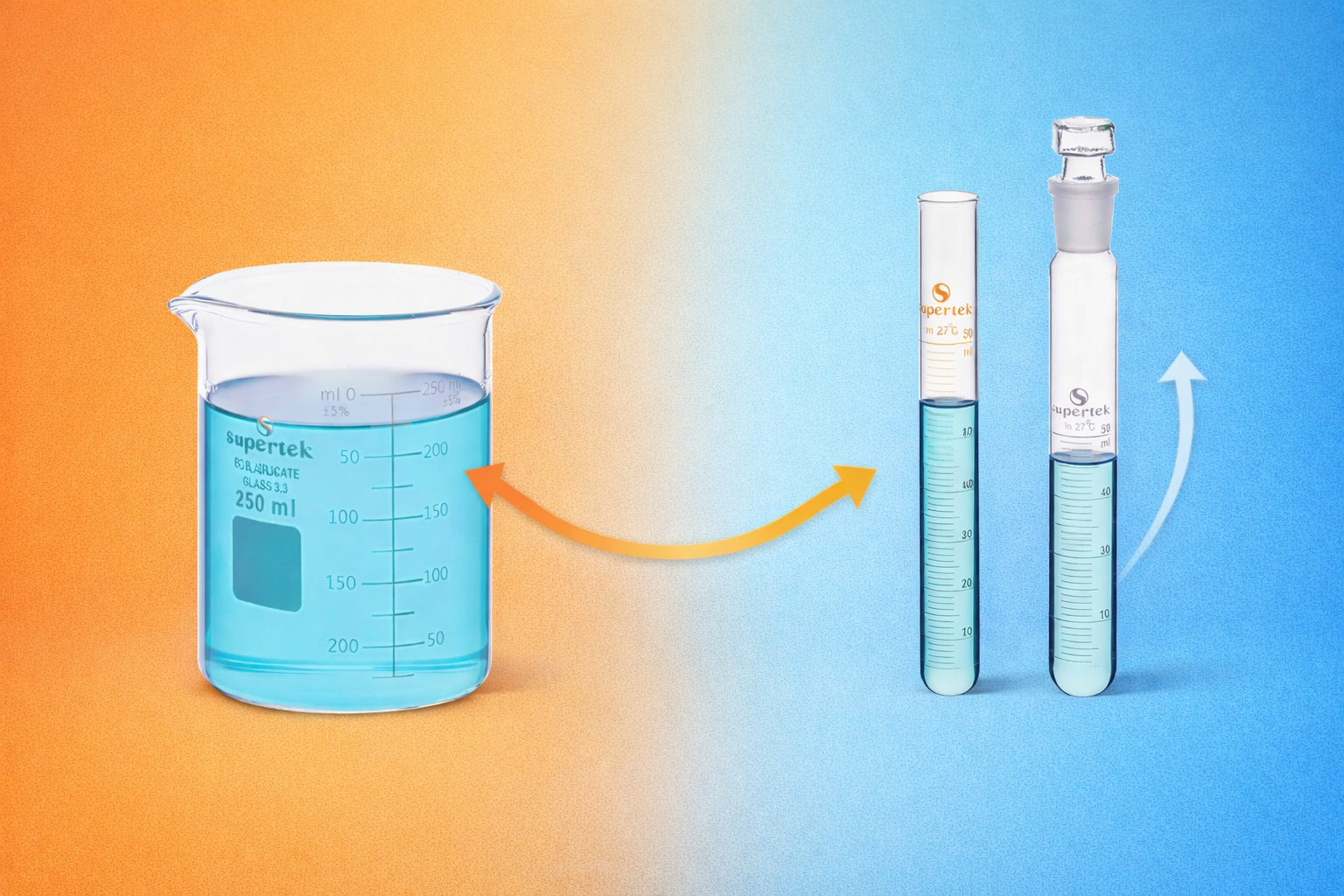
Beaker vs Graduated Cylinder: Key Differences Explained
In a science lab, even simple tools matter a lot. If you have ever worked with liquids, you’ve probably come across the question of beaker vs graduated cylinder. At first glance, both may look like basic containers, but they are used differently.
Lab equipment is designed for specific purposes. Using the wrong tool can lead to small errors, and sometimes those errors can affect the whole experiment. That is why understanding basic laboratory beaker uses and measuring tools is important.
A beaker is mostly used to hold and mix liquids, while a graduated cylinder is used for measuring them. Both are important, but they are not interchangeable. Knowing when to use each one makes your work easier and more accurate.
What is a Beaker?
A beaker is one of the simplest tools you will find in a lab. If you are thinking about what is a beaker used for, it is mainly for handling liquids in a general way.
It usually has a wide opening, straight sides, and a flat bottom. Most beakers also have a small lip or spout to help with pouring. They come in different sizes and are made from glass or sometimes plastic.
The beaker used in chemistry lab is helpful for:
- Mixing different solutions
- Heating liquids over a flame or a hot plate
- Holding substances during experiments
When it comes to the beaker function in the laboratory, it is more about convenience than precision. The markings on a beaker are not exact, so you should not rely on it for accurate measurements.
What is a Graduated Cylinder?
A graduated cylinder is designed for measuring liquids correctly. Among the many graduated cylinder uses in laboratory, accuracy is the most important one.
It is tall and narrow, with clear markings running along the side. This shape helps in measuring liquids more precisely compared to wider containers like beakers. Because of this precision, it is often considered a basic form of volumetric glassware, which is used when accurate measurements are required.
Some common uses include:
- Measuring exact liquid volumes
- Doing displacement experiments
- Preparing solutions that need the correct quantities
Because of its design, it offers better measuring accuracy. Even small differences in volume can be noticed easily, which is why it is preferred in experiments where measurement matters.
Beaker vs Graduated Cylinder: Key Differences
To understand the difference between beaker and graduated cylinder, it helps to look at them side by side:
| Feature | Beaker | Graduated Cylinder |
| Accuracy | Low, only gives an estimate | High, gives close to exact readings |
| Shape & Design | Wide and open | Tall and narrow |
| Measurement Precision | Not reliable | Reliable |
| Use Cases | Mixing, heating, holding | Measuring liquids |
| Cost | Usually lower | Slightly higher |
| Handling | Easy to use | Needs careful handling |
Accuracy Comparison: Which One is Better?
When comparing beaker vs graduated cylinder accuracy, the graduated cylinder is the better choice, no doubt about it.
The reason is simple. Its narrow shape allows you to read the liquid level more clearly. You can also see the meniscus, which is the slight curve at the top of the liquid, and measure from it properly.
Beakers, on the other hand, are too wide for precise reading. Still, they are fine when you just need an approximate amount, and exact numbers are not important.
When to Use a Beaker vs a Graduated Cylinder
Understanding beaker and graduated cylinder uses makes lab work much smoother.
Use a beaker when:
- You are mixing solutions
- Heating is involved
- You only need a rough idea of volume
Use a graduated cylinder when:
- You need exact measurements
- You are doing analytical or detailed experiments
- Accuracy affects the final result
In most labs, the choice between a lab beaker and graduated cylinder depends on the task. For example, you might measure liquid in a cylinder first and then transfer it to a beaker for mixing.
Measuring Cylinder vs Beaker in Educational and Research Labs
The difference between a measuring cylinder vs beaker is also seen in how they are used in different labs.
In schools, students usually use plastic cylinders and basic beakers. They are safer and less expensive.
In research labs, glass equipment is more common. Graduated cylinders are often calibrated properly, while beakers are used for general handling.
Cost and safety are also equally important in making the choice. Beakers are more durable, but graduated cylinders are chosen when precision is important.
Common Mistakes to Avoid
A few small mistakes can lead to wrong results:
- Using a beaker when you need an exact measurement
- Ignoring proper measuring cylinder accuracy methods
- Reading the meniscus from the wrong angle
- Choosing the wrong size of equipment
- Not placing the cylinder on a flat surface
Paying attention to these points can save a lot of time and improve accuracy.
Conclusion
The comparison of a lab beaker vs graduated cylinder is simple once you understand their purpose. A beaker is useful for mixing and handling liquids, while a graduated cylinder is made for accurate measurement.
Both tools are important in their own way. The key is to choose the right one based on what your experiment needs. If you focus on accuracy when it matters and convenience when it is enough, your lab work will become much more effective.
Explore quality laboratory glassware at Supertek to find reliable beakers, graduated cylinders, and other essential laboratory tools for your needs.