
No products in the cart.
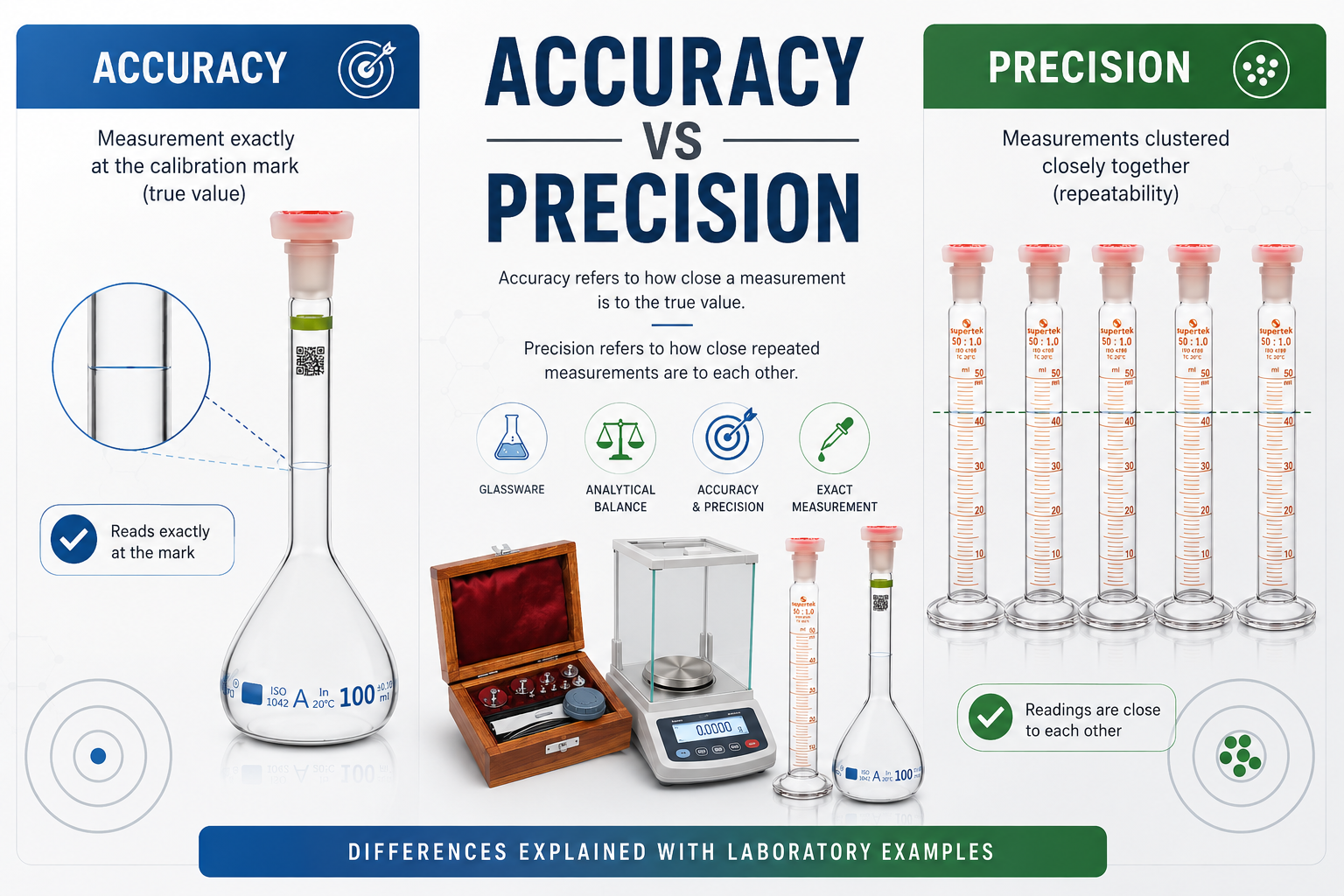
What Is the Difference Between Accuracy and Precision?
In science, everything comes down to measurement. Whether you are mixing a chemical solution, checking temperature, or weighing a sample, the result only matters if it is reliable. Hence, knowing the accuracy vs precision difference becomes important.
People often mix these terms up because they sound similar, and both can mean correct results to a layman. But in reality, they describe two very different qualities of measurement. Even in simple lab work, using the right instruments like a measuring cylinder or volumetric flask can change how dependable your results are.
In this article, we will understand what accuracy and precision are in chemistry, how they differ, and why both matter so much in real scientific work.
What is accuracy?
When we talk about accuracy, we simply mean how close a measurement is to the true value. If you are supposed to measure 100 mL and you get something very close to it, your result is accurate.
In scientific measurement, the goal is correctness. It is not about repeating the same number again and again, it is about getting the right number in the first place.
Accuracy is extremely important in fields like pharmaceuticals, chemical research, and laboratory testing because even a small mistake can change outcomes. In quality control labs, for example, a slightly incorrect reading can affect product safety.
A simple lab example helps here. If you measure liquid using a properly calibrated volumetric flask and the result matches the required volume closely, that is high analytical accuracy.
But accuracy does not depend only on tools. Several things can affect it:
- Calibration of instruments
- Human reading errors
- Environmental conditions like temperature
- Quality of equipment used
Even something as small as a tilted measuring cylinder can shift the final reading. That’s why labs rely heavily on good-quality equipment and laboratory glassware from trusted sources.
What is Precision?
Precision is not about being correct. It is about being consistent. If you measure something again and again and keep getting almost the same result, your readings are precise, even if they are slightly off from the actual value. This is called analytical precision or repeatability. It shows how stable your measurement process is.
Imagine you are measuring 50 mL of liquid five times and get:
50.1, 50.0, 50.1, 50.0, 50.1
These values are not perfect, but they are very close to each other. This is good precision. In real laboratory work, precision matters because experiments must be repeatable. If someone else performs the same test, they should get similar results.
A few things that affect precision include:
- Stability of instruments
- Skill of the person handling equipment
- Environmental fluctuations
- Consistency in method
Even slight changes in technique can disturb precise measurements in chemistry, especially in sensitive experiments.
Accuracy vs Precision: Key Differences
One of the easiest accuracy vs precision examples is a dartboard. If you hit the center, you are accurate. If all your darts land close together, you are precise. If you manage both, you are doing really well. In science, the same idea applies.
Here’s a simple comparison of accuracy and precision:
| Feature | Accuracy | Precision |
| Meaning | Closeness to true value | Closeness of repeated results |
| Focus | Correctness | Consistency |
| Affected by | Systematic errors | Random errors |
| Importance | Valid results | Repeatable results |
| Example | Hitting bullseye | Grouped shots |
The key thing to remember is that accuracy and precision are not the same thing. A result can be one without being the other. For example, a faulty instrument may give the same wrong reading every time. That is precise, but not accurate.
Can a Measurement Be Accurate but Not Precise?
Yes, it can happen very often. A measurement can be accurate but not always precise when the average result is close to the correct value, but individual readings keep changing.
For example, if a substance should weigh 10 g and repeated readings show 9 g, 11 g, 10 g, 9.5 g, the average may still come close to 10 g. That means accuracy is there, but consistency is missing.
In real labs, this usually creates confusion because the results don’t stay stable. It affects measurement reliability, especially when small differences matter.
Can a Measurement Be Precise but Not Accurate?
Yes, and this is also very common in lab work. A measurement is precise but not accurate when all readings are almost identical, but still wrong.
For example, if a weighing machine is not calibrated properly and always shows 9.5 g instead of 10 g, every reading will match, but all are incorrect.
This shows strong consistency but poor correctness. That is why calibration is not optional in laboratories. Without it, even advanced instruments can give misleading results.
Types of Measurement Errors That Affect Accuracy and Precision
Every experiment has some level of measurement error. These errors are usually divided into two types.
Systematic Errors
Systematic errors are predictable and repeat in the same direction. They mainly affect accuracy. Common causes include:
- Incorrect calibration
- Defective instruments
- Environmental interference
For example, if a thermometer always reads 2°C higher, every result will be shifted.
Random Errors
Random errors are unpredictable and vary from reading to reading. These mostly affect precision.
They may happen due to:
- Slight reading differences
- Human observation variations
- Small temperature changes
When these errors occur, results scatter instead of staying consistent. Understanding both is important for reducing measurement uncertainty in experiments.
Real Laboratory Examples of Accuracy and Precision
Let’s look at how accuracy and precision in laboratory measurements actually work in real settings.
Volumetric Flask
A volumetric flask is used when very accurate volumes are needed, especially while preparing standard solutions. Even a small error can change the concentration. That is why it is designed for high accuracy.
Measuring Cylinder
A measuring cylinder is often used for approximate volume measurements. Repeating readings with it helps understand precision.
Analytical Balance
An analytical balance is one of the most trusted instruments in labs. It provides both accurate and repeatable results when used correctly.
Chemical Titration
Titration is a classic example where both accuracy and precision are needed. Even a small reading mistake can affect the final concentration.
Why Accuracy and Precision are Important in Scientific Experiments
In real experiments, results only matter if they can be trusted. The importance of accuracy in experiments is that it ensures the result is correct. Without it, conclusions can be completely wrong.
On the other hand, the importance of precision in laboratory work lies in repeatability. If results cannot be reproduced, they lose scientific value.
Together, both improve laboratory data quality, reduce errors, and support industries like healthcare, pharmaceuticals, and research. Even regulatory approvals depend on how reliable the measurements are.
How to Improve Accuracy and Precision in the Laboratory
Good results do not happen by chance. They come from proper practice. To improve accurate measurements in laboratory work, you can:
- Use calibrated instruments
- Choose quality glassware
- Follow standard procedures
- Train lab users properly
- Keep conditions stable
- Maintain equipment regularly
Even small discipline in handling instruments can improve results significantly.
Also Read: You can also read our Beaker vs Graduated Cylinder to understand how these laboratory containers differ in accuracy, design, and practical applications in everyday lab work.
Conclusion
Accuracy vs precision is about two different sides of measurement. Accuracy means how close you are to the correct value. Precision means how consistent your results are.
Both are equally important in scientific measurements. Without them, experiments lose meaning. That is why laboratories depend on properly calibrated tools and reliable glassware from Supertek Glassware to produce results that can be trusted.
FAQs
Accuracy means how close a measurement is to the real or accepted value. If your result matches the true value, or comes very close to it, it is considered accurate. In scientific work, accuracy is important because even small deviations can change final conclusions.
Precision is how consistent repeated measurements are. If you measure something many times and get nearly the same values, the results are precise. It does not guarantee correctness, but it shows stability in the measuring process.
The main difference is that accuracy is about being correct, while precision is about being consistent. A measurement can be one without the other, but good scientific results usually require both working together.
Yes, this happens when the average result is close to the true value, but individual readings vary a lot. It shows that the method is not stable even if the final result seems correct.
Yes, this occurs when repeated readings are very similar but all are wrong due to calibration issues or systematic errors. It is a common issue in faulty instruments.
They are important because chemical reactions depend on exact quantities. Incorrect or inconsistent measurements can change reactions, affect safety, and reduce reliability of results in experiments.
A systematic error is a repeated error that shifts all results in one direction. It usually comes from faulty calibration or defective equipment and will mainly affect accuracy.
Random error causes small, unpredictable changes in readings. It is usually caused by human or environmental factors and mainly affects precision.
Accuracy can be improved by using calibrated instruments, following proper procedures, and ensuring equipment is regularly checked. Good training and stable conditions also help improve results.
Instruments like volumetric flasks, analytical balances, and calibrated pipettes provide very high accuracy. When maintained properly, they are very important for reliable laboratory work.