
No products in the cart.
Top 15 Must-Have Laboratory Equipment for Educational Institutions
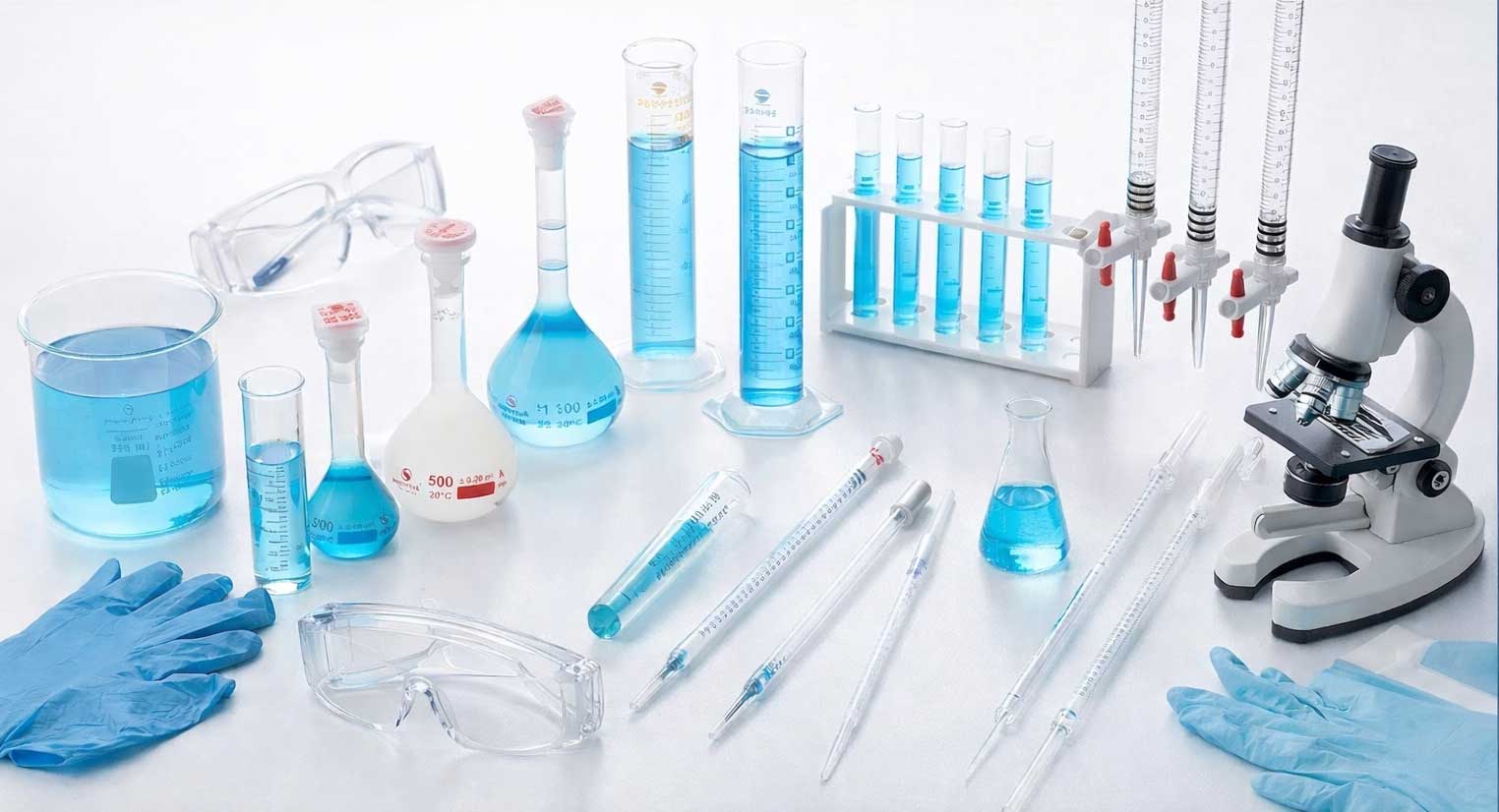
Well-equipped laboratories play a vital role in science education. They help students understand concepts through hands-on learning and practical experiments. From basic observations to accurate measurements, the right science lab equipment for schools and colleges ensures safety, clarity, and effective learning in school and college laboratories.
1. Beakers
Beakers are one of the most commonly used containers in educational laboratories. They are used primarily for holding, mixing, and heating liquids during experiments. In schools and colleges, beakers usually come in sizes such as 50, 100, 250, 500, and 1000 ml.
Students use beakers for simple chemical reactions, solution preparation, and demonstrations. Although they have graduation marks, they are meant for approximate measurements rather than precise volume calculations.
Measuring Cylinders
Measuring cylinders are essential for accurate volume measurement of liquids. They are more precise than beakers and are commonly used in both chemistry and physics experiments.
Glass cylinders offer higher accuracy and chemical resistance, while plastic ones are safer for younger students. In chemistry labs, they help measure solutions accurately. In physics labs, they are often used for displacement experiments to find the volume of irregular objects.
Test Tubes
Test tubes play a key role in qualitative analysis and small-scale experiments. They are used to observe reactions, color changes, gas formation, and temperature effects.
Schools and colleges typically use standard glass test tubes and boiling test tubes. Proper handling is important, as test tubes can crack when heated unevenly. Using test tube holders and racks helps maintain safety during experiments.
4. Conical (Erlenmeyer) Flasks
Conical flasks are preferred for mixing liquids because their narrow neck reduces the risk of spillage. They are widely used in educational lab experiments involving titration, heating, and swirling solutions.
Compared to beakers, conical flasks offer better control during mixing and are easier to handle. Their shape also makes them suitable for the temporary storage of reaction mixtures during practical sessions.
5. Volumetric Flasks
Volumetric flasks are designed for preparing solutions with very high accuracy. They are commonly used when students learn about molarity, normality, and standard solutions.
In academic labs, common sizes include 100 ml, 250 ml, 500 ml, and 1000 ml. Each flask has a single calibration mark that ensures precise volume preparation, making them an important part of basic chemistry laboratory equipment.
6. Burettes
Burettes are mainly used in titration experiments, which are a core part of chemistry practicals. They allow controlled and accurate release of liquids, usually acids or bases.
Accuracy is crucial when using burettes, so proper reading at eye level is important. Students are taught to handle burettes carefully, clean them thoroughly, and remove air bubbles to get reliable experimental results.
7. Pipettes (Volumetric and Graduated)
Pipettes measure and transfer small volumes of liquids with precision. Volumetric pipettes deliver one fixed volume, while graduated pipettes can measure different amounts.
Educational institutions commonly use glass or plastic pipettes along with pipette fillers for safety. They are essential laboratory equipment for schools, used for analytical experiments and help students learn accurate liquid handling techniques.
8. Reagent Bottles
Reagent bottles are used for storing chemicals and prepared solutions safely. Proper storage prevents contamination and accidental reactions.
Clear labeling with chemical names, concentration, and hazard symbols is very important in student labs. Glass reagent bottles are ideal for chemicals, while plastic bottles are preferred for solutions that may be handled frequently by students.
9. Bunsen Burner / Spirit Lamp
Heating is an important part of many experiments, and this is where Bunsen burners or spirit lamps are used. Bunsen burners provide controlled flame and are common in senior school and college labs.
Spirit lamps are safer for younger students and basic experiments. Teaching students fire safety, flame control, and proper shutdown procedures is essential in educational laboratories.
10. Laboratory Balance
Laboratory balances are used to measure the weight of solids accurately. This is important in chemistry, biology, and physics equipment for schools.
Educational labs usually use mechanical balances or digital balances, depending on the level of study. Accurate weight measurement helps students understand ratios, chemical equations, and material properties clearly.
11. Thermometer
Thermometers measure temperature changes during experiments such as heating reactions, boiling points, and cooling curves.
Mercury thermometers were traditionally used, but digital thermometers are now preferred due to safety concerns. Both types help students observe how temperature affects physical and chemical changes in different experiments.
12. Microscope
Microscopes are essential for biology education. They allow students to observe cells, tissues, structures, and microorganisms that are not easily visible to the naked eye.
Schools usually use compound microscopes, while colleges may also include binocular or advanced models. Microscopes help students develop observation skills and understand life science concepts more clearly.
13. Petri Dishes
Petri dishes are mainly used in biology and microbiology labs for growing cultures and observing microorganisms.
In educational settings, they help students learn about bacterial growth, fungi, and cell behavior in a controlled environment. Petri dishes are usually made of glass or disposable plastic and must be handled with proper hygiene practices.
14. Funnel (Glass and Plastic)
Petri dishes are mainly used in biology and microbiology labs for growing cultures and observing microorganisms.
In educational settings, they help students learn about bacterial growth, fungi, and cell behavior in a controlled environment. Petri dishes are usually made of glass or disposable plastic and must be handled with proper hygiene practices.
15. Safety Equipment (Goggles, Gloves, Lab Stands)
Safety equipment is the backbone of any educational laboratory. Goggles protect eyes from splashes, gloves prevent direct contact with chemicals, and lab stands support apparatus during experiments.
Other important safety items include aprons, fire extinguishers, and first-aid kits. Teaching students to use safety equipment properly builds good laboratory habits and reduces the risk of accidents during practical sessions.
Glassware vs Plasticware in Educational Laboratories
Choosing between glass and plastic equipment depends on the experiment and the student’s level. Glassware is preferred for high-temperature reactions, chemical resistance, and accuracy. It is commonly used in advanced experiments.
Plasticware, on the other hand, is lightweight, durable, and safer for beginners. It is ideal for routine handling and demonstrations. Cost, safety, and ease of maintenance should be considered while selecting items like laboratory glassware, plasticware, and other essential tools.
Maintenance and Care of Laboratory Equipment in Educational Institutions
Proper cleaning after every experiment ensures accuracy and extends equipment life. Glass items should be washed with mild detergents and dried properly.
Equipment should be stored in labeled cabinets to prevent damage and loss. Regular inspection helps identify cracks, leaks, or calibration issues early. Good maintenance practices save costs and keep labs safe and functional for daily use.
Choosing the Right Laboratory Equipment Supplier for Educational Institutions
Working with a certified educational lab equipment manufacturer ensures quality and safety standards. Reliable suppliers provide consistent products, proper documentation, and after-sales support.
Institutions trust experienced educational lab equipment suppliers like Supertek Glassware because they offer durable products, timely delivery, and expert guidance. Choosing the right partner helps schools invest confidently in long-lasting lab infrastructure and reliable lab equipment.
Conclusion
Well-equipped laboratories form the foundation of effective science education. From basic glassware like beakers and measuring cylinders to advanced tools such as microscopes and balances, every piece of equipment supports hands-on learning and concept clarity.
Investing in high-quality laboratory infrastructure improves safety, accuracy, and student confidence during experiments. Schools and colleges should always prioritize reliable suppliers like Supertek Glassware when sourcing laboratory tools.
Choosing durable, safe, and well-designed science lab supplies for schools helps create a productive learning environment that supports scientific curiosity and long-term academic growth.